What to do when there are schedule delays in Fixed Price projects especially because FP models demand strict scope, clarity, and predictability.
S – D – T – P
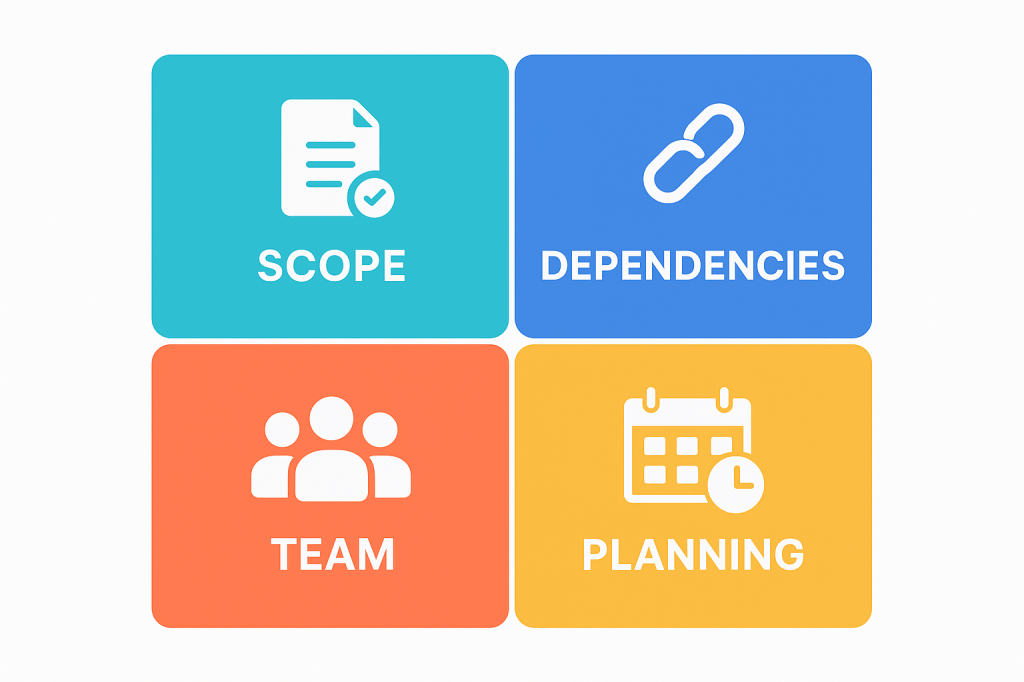
If a project timeline goes off track, the PM can quickly diagnose: Is it Scope? Dependency? Team? Planning?
Requirements & Scope Clarity Issues
These delays arise from unclear, incomplete, or evolving requirements.
- Unclear or poorly written requirements
- Scope creep / Implicit requirements emerging late
- Missing acceptance criteria
- Delayed sign-offs (BRD/SRS/design/UAT)
PM Reminder: “If scope isn’t tight, timeline won’t be right.”
Dependency & Environment Bottlenecks
Delays caused by things outside the dev team’s direct control.
- Dependencies not closing on time
- Third-party/API delays
- Environment access or readiness issues
- Test data not available
PM Reminder: “Track dependencies like deliverables.”
Team Capacity & Execution Challenges
Internal execution issues that slow down delivery.
- Unplanned long leaves
- Skill gaps in the team
- High rework due to assumptions
- Late identification of defects
- Poor coordination between workstreams
PM Reminder: “Velocity drops when the team struggles.”
Planning, Estimation & Risk Management Gaps
Delays caused by upstream planning mistakes.
- Underestimation during scoping
- Over-optimistic assumptions
- Risks not identified or mitigated early
- Unrealistic deadlines
- Poor onboarding of new members
PM Reminder: “Bad planning becomes the biggest dependency.” When delays come the PM’s role is not to push harder but to: clarify, support, reinforce, unblock, replan, communicate, and uplift.



Leave a comment